How to LAND airs surfing
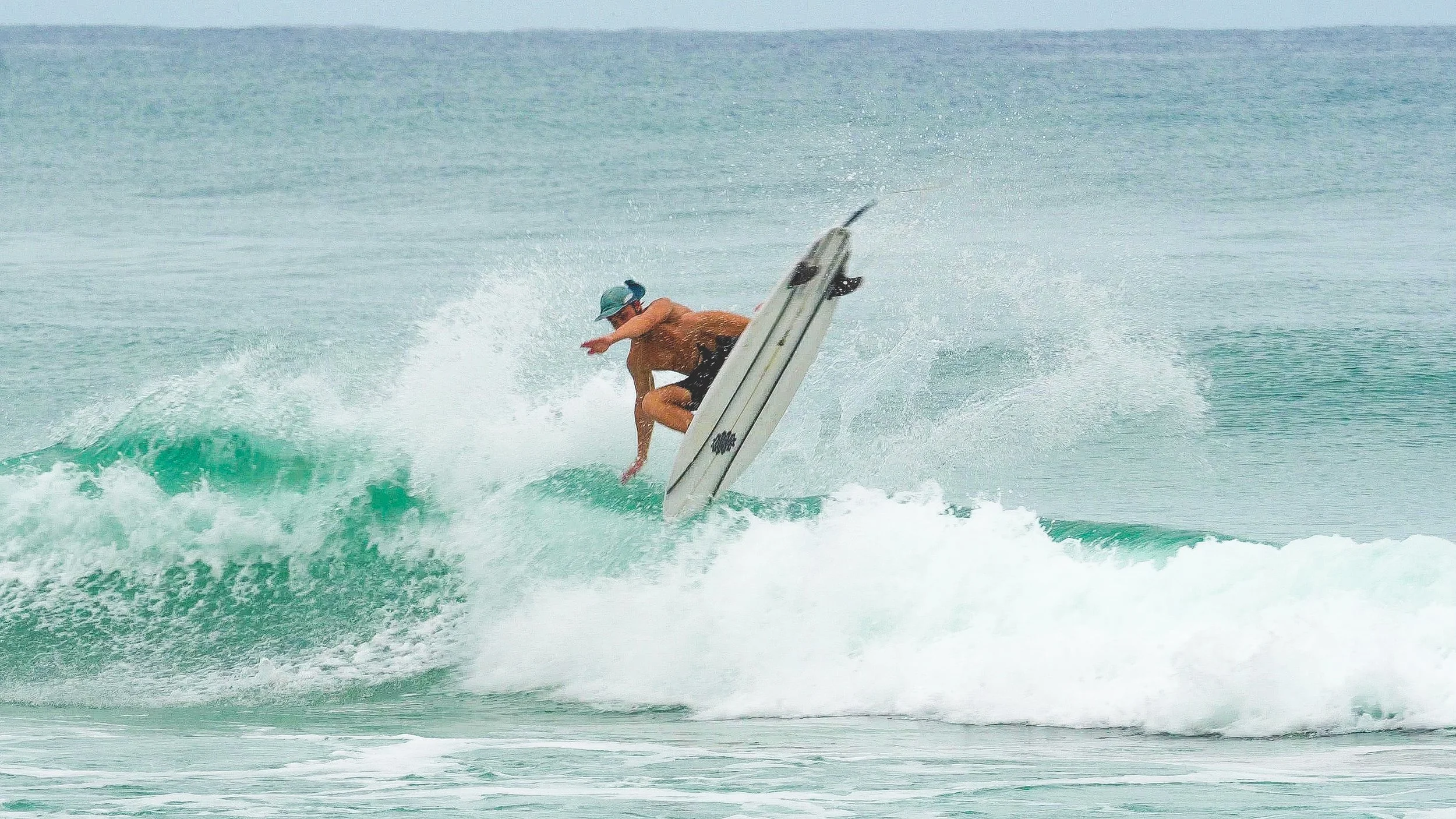
Everyone obsesses over the boost. How high, how much spin, how it looks freeze-framed on a phone screen. Almost nobody talks about the half a second that actually decides whether you ride away or crash, which is the moment your board touches back down. We went looking for the real research on that moment, and there's more of it than you'd think, straight from biomechanics labs studying pro and junior surfers.
Here's the simple version, broken down by moment.
1. The approach
You need more speed than feels natural. That's it, that's the main thing.
Chase smaller, doubled-up waves that bounce off a point or a bank, not big clean set waves. That rebound gives you extra lift.
Keep your bottom turn shallow and mid-face, not deep and vertical. A shallow turn keeps your speed up and sets up your spin.
Rule of thumb from the pros: the shallower the turn, the more spin you get off the top.
2. The pop
Launching off the lip is like an explosive skateboard ollie, not a gentle hop.
Compress through your knees and hips first.
Then explode upward, hard and fast.
A half-hearted crouch won't get you airborne. The compression has to be real and the release has to be sudden.
3. In the air
Once you're up, the job is control.
Lock the board to your feet, either with a grab near the middle of the rail or firm foot pressure. This stops the board drifting away from you mid-air.
Look at your landing. Pick the exact spot on the wave where you plan to touch down before you even leave the lip, and keep your eyes on it the whole time you're airborne.
Don't look down at your board or your feet. That's what makes surfers lose track of their spin and miss the landing.
4. The landing (this is where the real science is)
This is the part almost nobody coaches properly, and it's the part backed by the strongest research.
The single biggest factor in a clean landing is ankle flexibility, specifically how far you can bend your foot upward toward your shin. Surfers with more flexible ankles land with far less shock hitting their knees and hips. A stiffer ankle dumps all that force in one hit instead of spreading it out.
Your weight needs to be centred directly over the board when you land, not out over the nose and not hanging back over the tail. This matters whether you're doing a straightforward air or a rotating one.
Your front leg and back leg do different jobs. Your front leg takes most of the landing force and holds your weight. Your back leg is mostly there for balance.
A straightforward frontside air hits your legs harder and faster on landing than a rotating air reverse does, even though your body moves in a similar way for both.
Stance matters too: land a frontside air with your feet a bit wider than hip width. For a rotating air reverse, keep your chest stacked over your front knee rather than standing tall. Both keep your weight low and centred, which is exactly what protects you.
5. Training it before you need it
Ankle flexibility and landing control are both trainable on dry land. You don't need a wave for either.
A 2024 study had junior surfers do balance work, jump training, and landing drills twice a week for seven weeks.
Results: ankle flexibility improved noticeably, left-right balance evened out by over half, and jump height went up more than 8%.
None of that needed a single wave. Just cones, a balance board, a box, and consistent practice.
Even simpler: a trampoline, a crash mat, and a soft top board let you rehearse the exact landing position (weight centred, knees soft, ankle absorbing) again and again with zero wipeout risk.
Basic calf stretching also helps loosen up your ankles over time.
The short version
Get more speed than feels comfortable.
Keep the bottom turn shallow.
Explode off the lip, don't hop.
Look at your landing spot the second you take off.
Land with your weight centred and your ankle soft, ready to absorb, not brace.
Everything else is just style.
If you want a coach actually watching where your weight lands and how your ankle moves, frame by frame, that's exactly what video analysis is built for. It's a faster way to fix your landing than another few sessions of trial and error. Get in touch or check the website for what that looks like at the moment.
Sources
Forsyth, J. et al. (2018). "Understanding successful and unsuccessful landings of aerial maneuver variations in professional surfing." Scandinavian Journal of Medicine & Science in Sports. https://onlinelibrary.wiley.com/doi/10.1111/sms.13055
"Rate of loading, but not lower limb kinematics or muscle activity, is moderated by limb and aerial variation when surfers land aerials." Journal of Sports Sciences, 39(15) (2021). https://www.tandfonline.com/doi/abs/10.1080/02640414.2021.1898167
"Are the Kinetics and Kinematics of the Surf Pop-Up Related to the Anthropometric Characteristics of the Surfer?" PMC (2021). https://pmc.ncbi.nlm.nih.gov/articles/PMC7961430
"Effect of a Sensorimotor Training Program for Aerial Maneuvers in Junior Surfers." Applied Sciences, 14(22), 10159 (2024). https://www.mdpi.com/2076-3417/14/22/10159
"Biomechanical Perspectives on Surfing Performance: A Scoping Review." Biomechanics/MDPI, 6(2), 36 (2024). https://www.mdpi.com/2673-7078/6/2/36
Surf Simply, "Flying High" (coaching breakdown citing Forsyth's landing research). https://surfsimply.com/magazine/flying-high
Wavelength Surf Magazine, "How To Start Boosting (And Landing) Airs, With Alan Stokes." https://wavelengthmag.com/how-to-start-landing-airs-alan-stokes/
Neptune, "How to Do an Aerial in Surfing: A Progressive Guide to Getting Airborne." https://neptune.coach/blog/how-to-do-an-aerial-in-surfing