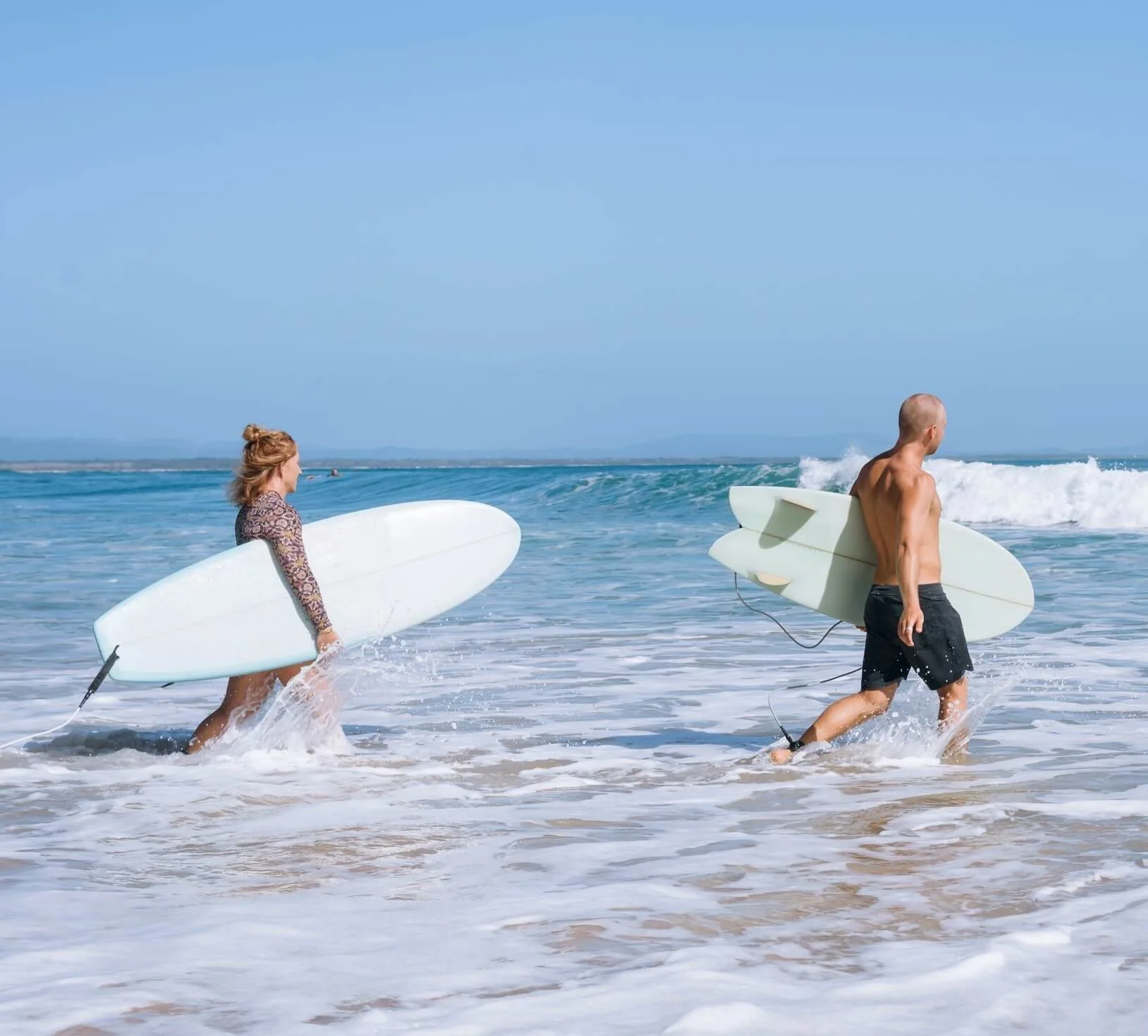
A rip current isn't malicious; it's just water finding the fastest way back out to sea. Its reputation as the villain of the Australian coastline comes down to one thing: most people never learn to spot one, figure out what kind it is, or use it. Surfers do the opposite of running from a rip. It's the fastest paddle-out on the beach, and every surfer who's ever sat out the back while everyone else grinds through set after set on the inside got there by reading exactly what beachgoers are told to avoid.
Not every rip behaves the same way, and knowing which kind you're looking at is most of the skill. Topographic rips are carved by the sandbars themselves, a channel of deeper water running between two shallower banks, showing up as a dark, calmer-looking gap in the whitewash. They can hold the same spot for weeks at a time, which makes them the easiest to learn and the ones we point out first. Fixed rips run alongside something permanent, a headland, a groyne, a rock shelf, a river mouth, and sit in the same place day after day, which is why you'll see surfers paddling out tight against the rocks at a point break instead of fighting through the impact zone in the middle. Flash rips are the ones that can catch you off guard. A bigger set pushes extra water onto the sand, and for a few minutes a rip fires somewhere it wasn't five minutes earlier, then it's gone. You can't scout a flash rip in advance, which is exactly why they catch people who were standing in ankle-deep water a moment before.
If you don't have the water time to tell one type from another yet, the advice is simpler than all of that: swim at a patrolled beach, between the flags, and let someone else worry about which kind of rip is running that day. It's worth knowing why that advice matters as much as it does. Research from UNSW puts the number of Australians who can't identify a rip current at close to 70%, standing right in front of one. Nationally, rips are estimated to kill around 30 people a year, more than bushfires, floods, cyclones and shark attacks combined, and there are roughly 17,000 of them running on Australian beaches at any given moment, across 11,000 beaches, with only 4% of those beaches patrolled. Professor Rob Brander, who's spent decades studying rips at UNSW, sums up the real danger better than any safety poster: "Rips don't drown people, people drown in rips." The current itself is rarely stronger than a fit swimmer. Panic does the damage: swimming against it, burning out, going under while fighting something you were never going to beat by fighting it. If you do end up in one, don't fight it: float, or swim parallel to the beach, and let it spit you out past the break where you can catch a wave back in or wait for it to weaken, which most rips do within fifty to a hundred metres of the shore. Raise an arm, call out, and swim toward a patrolled beach whenever you have the choice.
Coming into summer, patrol coverage on this stretch of coast changes fast, and it's worth knowing where you stand. Peregian, Sunshine Beach and Noosa Main sit in Noosa Shire, a separate system contracted to Surf Life Saving Queensland: professional lifeguards patrol all three daily, year-round, with volunteer surf clubs adding weekends and public holidays through spring, summer and autumn (Sundays only at Peregian, every weekend at Sunshine Beach and Noosa). South of the Noosa River, Sunshine Coast Council runs its own network of 21 beaches from Coolum down to Bulcock Beach. Most of the big ones, Alexandra Headland, Coolum, Kings, Kawana, Maroochydore, both Mooloolaba beaches and more, are patrolled year-round, while several others step up to seven days a week once the summer school holidays hit and drop back to weekends the rest of the year. We put together a full beach-by-beach patrol guide covering all 25 beaches on both sides of the river if you want the complete list before you head out. Short version either way: check the flags on the day, patrol tiers get reviewed every year, and a blog post is never going to be as current as what's flying above the sand.
Every Patrolled Beach on the Sunshine Coast This Summer
Noosa Shire
Contracted to Surf Life Saving QueenslandSunshine Coast Council
Coolum to Bulcock Beach, 21 locationsKnowing the roster isn't the same as reading the water
A patrol schedule tells you when someone else is watching. It won't teach your own eye to spot a rip, judge a bank, or pick the right day to paddle out. That only comes from time in the water with someone who can point at it and show you. If you want to actually understand the ocean instead of just checking a timetable, a lesson is the fastest way there, get in touch or check the website for what we've got running.
None of this is really learnable from a blog post, ours included. Reading about a topographic rip and picking one out at Peregian at seven in the morning with glare on the water and a bit of chop are two different skills, and the second one only comes from time in the water with someone experienced enough to point at it and say "there, see that," over and over until your own eye starts doing the work. That's most of what a surf lesson is really teaching, underneath the pop-ups and the turns: how to read the ocean itself, with a coach who already knows which rip is running that day and why. If you want to understand the water rather than just be told which parts of it to avoid, get in touch or check the website for what we've got running.
Sources:
Brander, R. (UNSW), rip current and drowning research, via "Exposing the top danger to beachgoers," UNSW Sydney: https://www.unsw.edu.au/science/about-us/creating-impact/exposing-the-top-danger-to-beachgoers
Castelle, B., Scott, T., Brander, R.W. and McCarroll, R.J., "Rip current types, circulation and hazard," Earth-Science Reviews (2016), via Science of the Surf's "Types of Rip Currents": https://www.scienceofthesurf.com/types-of-rip-currents
Surf Life Saving Queensland: "Rip Currents" identification and survival guide: https://lifesaving.com.au/safety-info/rip-currents, plus patrol schedules for Peregian Beach (https://lifesaving.com.au/clubs-and-beaches/peregian-beach), Sunshine Beach (https://lifesaving.com.au/clubs-and-beaches/sunshine-beach) and Noosa Beach (https://lifesaving.com.au/clubs-and-beaches/noosa-beach)
Sunshine Coast Council: "The four words that could save your life": https://www.sunshinecoast.qld.gov.au/news/the-four-words-that-could-save-your-life, and "Patrolled beaches" directory: https://www.sunshinecoast.qld.gov.au/experience-sunshine-coast/sports-and-leisure/beaches/patrolled-beaches
Full companion reference: "Sunshine Coast Beach Patrol Guide" (all 25 beaches, both councils)